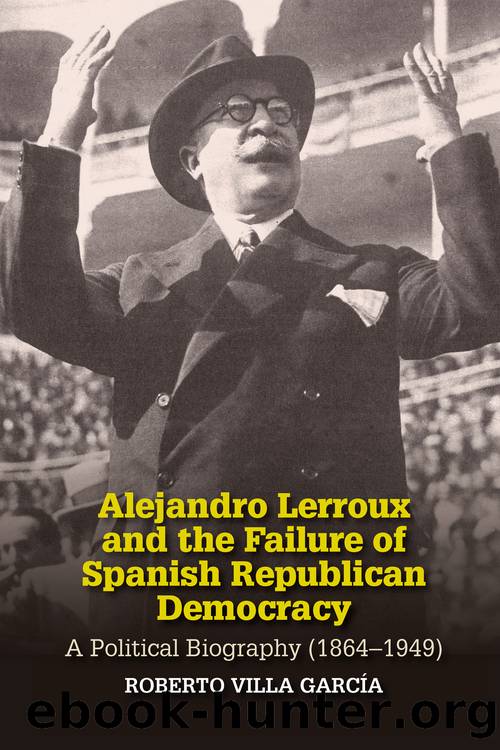
Alejandro Lerroux and the Failure of Spanish Republican Democracy by Roberto Villa García
Author:Roberto Villa García
Language: eng
Format: epub
Publisher: Sussex Academic Press
Published: 2020-11-12T00:00:00+00:00
The Sanjurjo Coup of August 1932
The deterioration of public order and the political storm over the Catalan Statute encouraged the gestation of a military conspiracy focussed on general Sanjurjo. Although he had accepted the Republic the previous year, socialist criticism of bloody clashes between the Civil Guard and the UGT in Castilblanco (Badajoz), Arnedo (Logroño) and other places in the winter of 1931â32 led to Sanjurjo being transferred from his command of the Civil Guard to the Carabineros, the customs police. Throughout this time, the general maintained his friendship with Lerroux, believing the Radical leader to be the personification of the true Republic of 14 April, and someone unwilling to sacrifice the national interest by agreeing to the demands of socialists or catalanists. Furthermore, Sanjurjo did not hide his disgust with Azañaâs military reforms, slights of the officer corps and postings from his political chum, and Lerroux had to convince him to accept the post of director general of the Carabineros.
If Sanjurjo did not convey a particularly sophisticated analysis of the shortcomings of the Republic to the Radical leader, some of his comrades-in-arms were prepared to offer a violent solution in the first months of 1932. They saw Sanjurjoâs prestige within the military as the magnet to attract those willing to stage a 1923-style pronunciamiento to overthrow the Azaña government. With the same naivety, they also sought to involve Lerroux in this madcap enterprise. After all, were republicans not inveterate conspirators? The Radical leader thought something was amiss when Sanjurjo invited him for dinner and railed against Azaña, telling him something that he already knew: a Radical government would not be poorly received by the officer corps. The veteran plotter suspected that he was being sounded out for his attitude towards a possible rebellion, but kept his silence having taken the precaution of bringing fellow Radicals MartÃnez Barrio and Azpiazu to the meal. Since the latter was a close associate of Sanjurjo, Lerroux used him to pass on the message that his scheming days ended in April 1931. He hoped to dissuade a general associated with his party not to ruin his reputation by getting involved in another one of the many comic opera risings that the republican had seen fail during his long political career.8
For Lerroux, the conspiracy was yet more evidence that Azaña had failed to consolidate the regime by the summer of 1932. It reinforced an optimism that the ever more popular Radicals were getting closer to power, as the creaking ship of government seemingly faced the imminent prospect of being torpedoed by the failures of Catalan autonomy and agrarian reform. Azañaâs majority was at risk by splits and (above all), non-attendance in debates. The relations between the left republicans, the PSOE and ERC were fractured, even if at this stage not quite yet beyond repair. A rebellion would only serve to resuscitate a political corpse.
Despite this, Sanjurjo resolved to continue. Lerroux tried to stave off a rising by negotiating a change of government in a secret
Download
This site does not store any files on its server. We only index and link to content provided by other sites. Please contact the content providers to delete copyright contents if any and email us, we'll remove relevant links or contents immediately.
| Anthropology | Archaeology |
| Philosophy | Politics & Government |
| Social Sciences | Sociology |
| Women's Studies |
The Secret History by Donna Tartt(19027)
The Social Justice Warrior Handbook by Lisa De Pasquale(12182)
Thirteen Reasons Why by Jay Asher(8883)
This Is How You Lose Her by Junot Diaz(6871)
Weapons of Math Destruction by Cathy O'Neil(6260)
Zero to One by Peter Thiel(5782)
Beartown by Fredrik Backman(5734)
The Myth of the Strong Leader by Archie Brown(5491)
The Fire Next Time by James Baldwin(5423)
How Democracies Die by Steven Levitsky & Daniel Ziblatt(5211)
Promise Me, Dad by Joe Biden(5139)
Stone's Rules by Roger Stone(5078)
A Higher Loyalty: Truth, Lies, and Leadership by James Comey(4946)
100 Deadly Skills by Clint Emerson(4911)
Rise and Kill First by Ronen Bergman(4775)
Secrecy World by Jake Bernstein(4738)
The David Icke Guide to the Global Conspiracy (and how to end it) by David Icke(4696)
The Farm by Tom Rob Smith(4500)
The Doomsday Machine by Daniel Ellsberg(4481)
